On April 5, US President Donald Trump said that China, Russia and the US are all making hundreds of billions of dollars worth of weapons, including nuclear, which is ridiculous and that he thinks it’d be much better if they all got together and didn’t make these armaments.
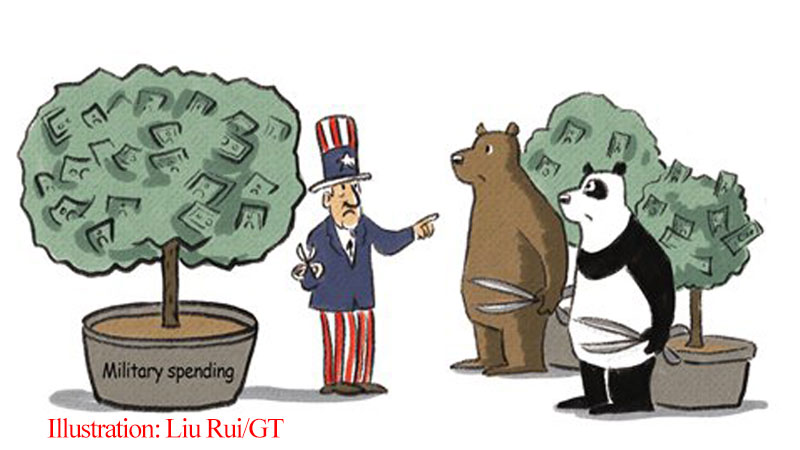
This is doubtful because the Trump administration has been increasing military spending and hyping up great power rivalries. Trump’s suggestion may be hard to achieve in the short term considering his political preferences and the US foreign and national security strategies.
Trump has been advocating “America First” since he took office. He has emphasized reviving US strength, especially economic and military power. His first act was to increase his country’s defense spending. In 2018, the US Congress passed the National Defense Authorization Act (NDAA) for fiscal year 2018 which supported “a national defense topline of $700 billion.”
The NDAA also supported $716 billion for fiscal year 2019 for national defense. This is in sharp contrast with the Obama administration’s prudent national defense budget.
Second, Trump has been urging US allies to shoulder more responsibility for national defense. The US not only required its NATO allies to increase the proportion of defense spending, but also pressed allies in the Asia-Pacific region, such as Japan and South Korea, to pay a larger share for US forces stationed in their countries.
Third, Trump has been emphasizing great power rivalries to drum up development of the US military. The Trump administration’s national security strategy labeled geopolitics and great power rivalry as major threats, which are used by the administration as excuses to justify its increased military spending.
But the Trump administration cannot act arbitrarily. After all, the US House of Representatives controls budget authority and spending allocation. Without the Congress’ permission, the Trump administration cannot increase the national defense budget.
To win the Congress’ approval, Trump cut other expenses to make sure the total government budget did not increase too much. Indeed, the budget passed partly because the Republican Party was controlling the House. But now that the Democratic Party has taken back the House, it will not easily pass Trump’s increasing national defense budget. Considering the government shutdown over Trump’s demand for around $5 billion for a border wall, it may be difficult for him to increase national defense spending in a peaceful era.
Thus, Trump needs military accomplishments as he aims at re-election. In fact, this is not the first time that Trump suggested China, Russia and the US cut military expenditure. In December 2018, Trump called the $716 billion defense budget “crazy” in a tweet.
He said he would “start talking about a meaningful halt to what has become a major and uncontrollable arms race” with Chinese President Xi Jinping and Russian President Vladimir Putin. Trump has three reasons for doing so.
First, he wants to add pressure on China and Russia and to maintain the US’ leading military position. Although the US is still in the lead, it worries that China and Russia will narrow the gap. The Trump administration believes that China and Russia’s military development will be restricted as long as their military expenditure is restricted.
Second, Trump wants an excuse to increase the national defense budget. He knows it is hard to drastically increase military expenditure in peaceful times, but it can be justified if Washington’s major rivals increase their budgets. If China and Russia do not follow his suggestion of cutting their military expenditures, the Trump administration may hike it.
Third, Trump needs to consolidate his political basis. As US internal politics is polarized, military groups are an important supporting base. Trump needs to increase national defense spending to maintain their support.
China and Russia have responded positively to Trump’s suggestion. But it is not easy for major powers to jointly cut military expenditure. Considering the US’ military expenditure is much higher than that of China and Russia, Washington may need to cut its budget first. But this may be hard to do because of the US’ hostility toward China and Russia. There is a lack of trust and no specific plans for the three countries to cut their budgets together. Trump may need to further show his sincerity by taking the initiative to cut the US military budget.
The author is secretary-general of the International Security Study Center at China Foreign Affairs University.
(In association with Global times)