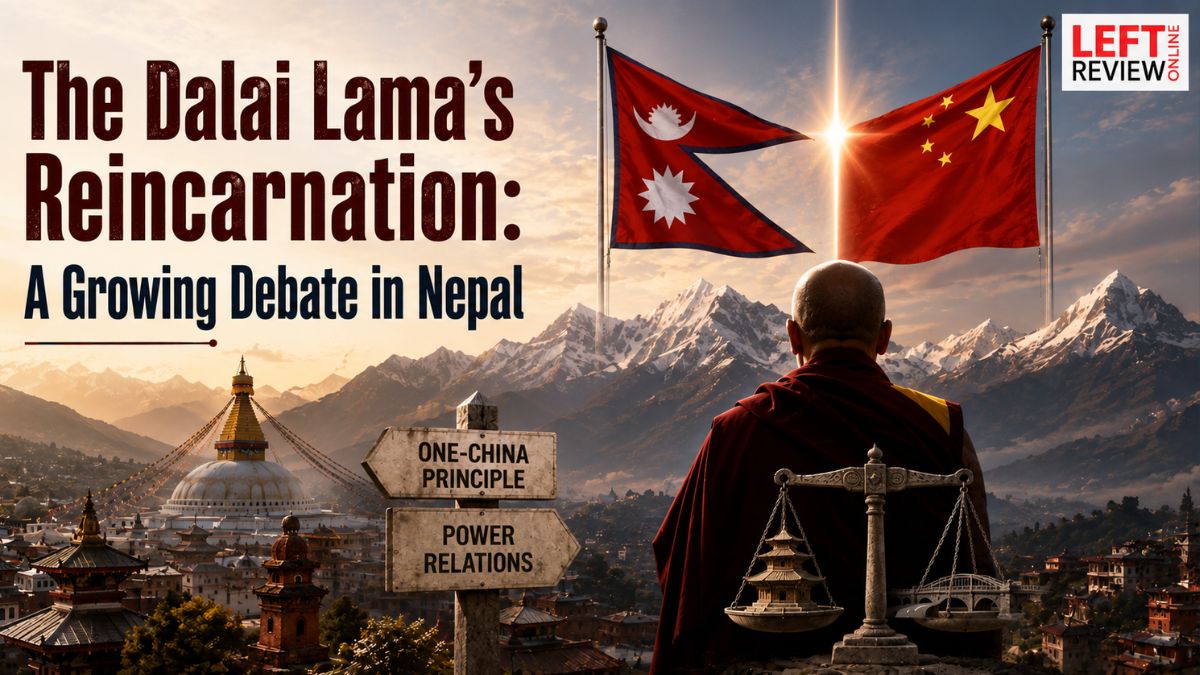
In 1959, the Dalai Lama led an uprising in China’s Xizang Autonomous Region (Tibet). He then fled to India and took refuge in Dharamshala. China characterized the uprising and the Dalai Lama’s political activities as separatist, while the Dalai Lama and his supporters have presented the events very differently.
China also considers the political activities of organizations aligned with him to be separatist and frequently describes them as part of “anti-China forces.” He later established a Tibetan government-in-exile in India, now known as the Central Tibetan Administration (CTA), which China does not recognize and regards as an illegal separatist organization. Since then, the Dalai Lama has remained an extremely sensitive figure in Nepal-China relations.
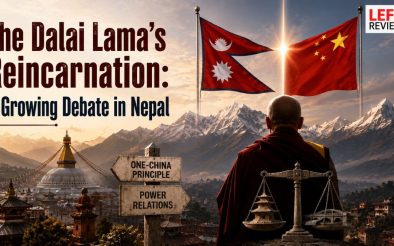
Nepal has consistently adhered to the “One-China Principle” and has restricted political activities by Tibetan groups that it considers inconsistent with that policy. Nepal has also not permitted the Dalai Lama to visit the country. On the other hand, the United States, European countries, Japan, India, Australia, Canada, and several other governments generally recognize the Dalai Lama primarily as a spiritual and religious leader. Some of these governments and international human-rights organizations have criticized restrictions imposed on Tibetan political activities in Nepal, framing such restrictions as matters of religious freedom and human rights.
Although the Dalai Lama is, above all, the spiritual leader of Tibetan Buddhism, he also exercised temporal and political authority in Xizang for many years as an executive power of the state. For that reason, he cannot be understood solely as a religious figure. Chinese authorities regard him primarily through a political and separatism-related lens, while many Western governments and institutions present him mainly as a spiritual and religious leader. Nepal therefore finds itself navigating between these competing interpretations, while trying to preserve its One-China policy, maintain stable relations with China, and respond to international concerns over religious freedom and human rights.
According to sources familiar with the discussions, the US Embassy also raised the issue of the 14th Dalai Lama’s reincarnation with some Nepali experts following the Gen Z unrest of September 8–9, 2025. Since then, the Dalai Lama’s reincarnation question has attracted increasing attention in Nepal’s political and diplomatic discourse.
This has occurred alongside a wider debate over foreign-funded youth engagement before the Gen Z riot. US Embassy-linked programs had provided Nepali youths with training in leadership, civic engagement, information technology, artificial intelligence, digital communication, and other professional skills. The subsequent movement brought figures such as then-Kathmandu Mayor Balendra Shah (Balen) into the centre of the country’s political transition, while Sudan Gurung, founder of Hami Nepal, emerged as one of the prominent organizers associated with the Gen Z mobilization and the use of digital platforms such as Discord. Both later became important figures in the new political order: Shah became Prime Minister in March 2026, while Gurung is now serving as Home Minister.
At the same time, several Nepali media reports and commentators have raised broader questions about whether foreign-funded networks and programs also helped shape the political narratives surrounding the movement. These included portraying leaders of the established political parties as systematically corrupt, popularizing the so-called “Nepo Baby” discourse around their children and family networks, and amplifying allegations of corruption in Chinese-funded projects.
Questions have also been raised about foreign-supported digital training and the technological capacity used by activists during the movement. Taken together, these developments have intensified debate in Nepal over the extent to which externally funded youth programs, digital capacity-building, domestic political grievances, anti-establishment narratives, and wider geopolitical interests may have intersected during the country’s political transition.
The 91st birthday of the 14th Dalai Lama was observed on July 6 with a programme at Namgyal Higher Secondary School in Nagarjun Municipality, Kathmandu. Traditionally, public celebrations of the Dalai Lama’s birthday in Nepal were rare; Tibetans in Nepal have marked it quietly, often within community or camp premises. This year, however, local authorities took an unusual formal step by allowing the event under specific conditions. Karma Gyaltsen, Coordinator of the Central Tibetan Administration (CTA), signed a five-point minute at the Chief District Officer’s office. The arrangement—the formal approval by a Government authority—is significant because it explicitly framed the celebration as a cultural and religious event while prohibiting political or anti-China activities. The written points also reaffirmed Nepal’s commitment to the One-China Principle while permitting a peaceful cultural observance. Officials and organizers, including Gyaltsen, signed the document, giving the event a degree of formal administrative recognition that had generally been absent in previous years.
After the birthday event, seven former Nepali ambassadors to China issued a joint statement criticizing the government’s handling of the matter, further intensifying the debate. The statement asked: “The commitment that Nepal will not allow its territory to be used in ways that create difficulties or adverse effects for any friendly country was reiterated during the Foreign Minister’s recent visit to China. Has that commitment changed now? Have we changed our foreign policy toward our neighbors?”
The Balen government appears to have adopted a policy of cooperating with China, particularly in development projects and cross-border connectivity. Interestingly, Nepal has begun to use the phrase “One-China Principle” in line with China’s interpretation. It began with the Beijing visit of then Prime Minister Pushpa Kamal Dahal ‘Prachanda’. Former Prime Minister K.P. Sharma Oli continued the same formulation, and the government led by Balendra Shah (Balen) now appears to be following the same course. Although the Rastriya Swatantra Party (RSP) had earlier expressed reservations about this formulation, the current RSP-led government and the party have also endorsed the One-China Principle, including in official communications issued by the Nepali Embassy in Beijing.
Nepal’s Minister for Foreign Affairs, Shisir Khanal, during his visit to China from June 14–17, 2026, emphasized that stronger connectivity with China is inevitable for Nepal’s development. In that context, the Balen government appears to be deepening cooperation with China—Nepal’s largest development partner, investor, and grant-providing northern neighbour—in areas such as infrastructure, investment, grants, and cross-border connectivity. At the same time, the Dalai Lama and his supporters, along with some Western governments and organizations, appear to have become more active in Nepal, seemingly interpreting the Balen government and new political environment as more open and favourable to push their concerns and agenda. This has created additional sensitivity in Nepal-China relations.
At a time when the government’s relations with the southern neighbour India are also facing periods of strain, the government should be pursuing a careful balancing strategy of seeking closer economic and developmental engagement with China while managing political pressures linked to wider geopolitical competition.
In conclusion, the recent rise in Tibetan political activity and anti-China mobilization in Nepal should be understood within a wider geopolitical context, including the long-standing involvement of the United States in Tibetan issues. From the early phases of the Tibetan movement in Nepal to the present, the US and Western support and engagement have remained an important factor in the political environment surrounding Tibetan activism. In the initial phase of the Balen-led government, such activities appeared to gain greater visibility. Going forward, the Nepal government should ensure that its territory is not used for activities that undermine the country’s stated One-China Principle or create unnecessary tensions with a friendly neighbour. At the same time, any corrective measures should be implemented consistently, transparently, and in accordance with Nepal’s laws and diplomatic commitments.