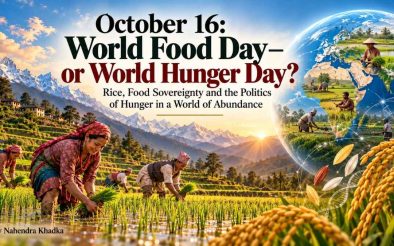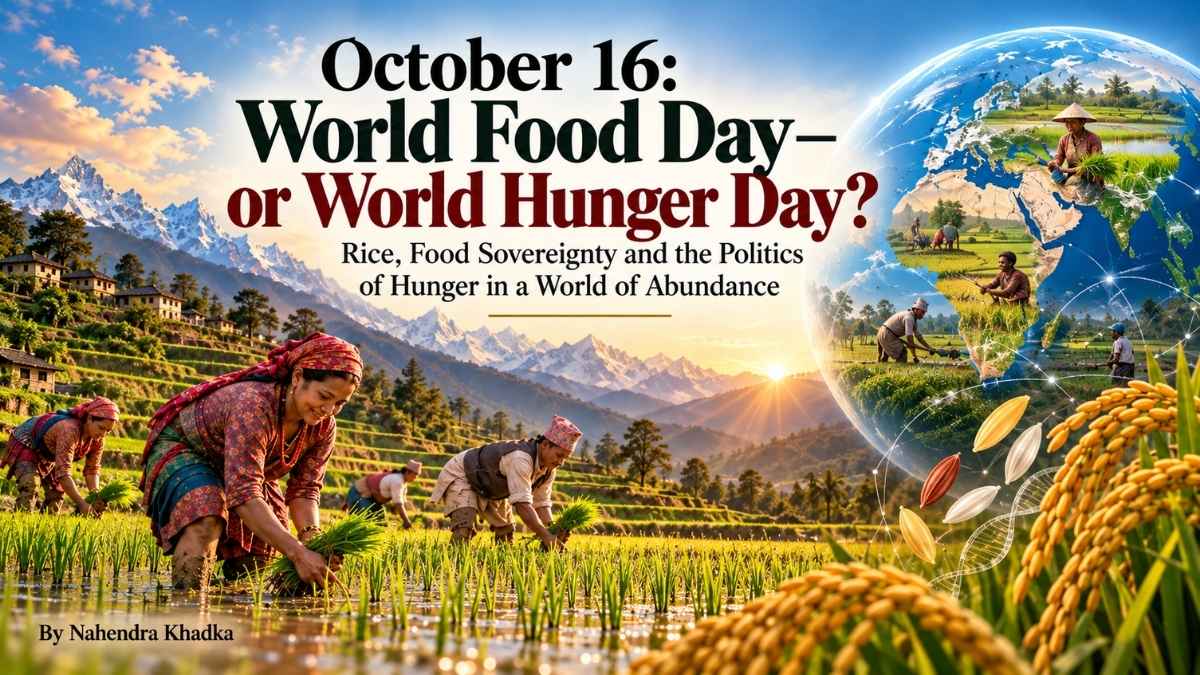
Every year on 16 October, the world observes World Food Day.
But across Asia and beyond, peasant movements have long asked a more uncomfortable question: Should October 16 be celebrated as World Food Day or observed as World Hunger Day?
The question is deliberately provocative. It does not deny the importance of World Food Day or the work being undertaken across the world to end hunger. It asks us to look beneath the celebration: at the millions who still go to bed hungry, at children whose development is damaged by malnutrition, and particularly at the farmers, agricultural workers, fisherfolk, rural women and other small-scale food producers who feed society while often remaining among its most economically vulnerable people.
The Asian Peasant Coalition (APC) began marking October 16 as World Hunger Day in 2012, drawing attention to landlessness, chronic hunger and the condition of rural food producers. The framing has since been carried forward by organisations including the People’s Coalition on Food Sovereignty (PCFS) and Pesticide Action Network Asia Pacific (PANAP). This year, PCFS is observing World Hunger Day under the call “Defend Our Food Systems!”
The purpose is not merely to replace one commemorative name with another. It is to expose a contradiction.
Humanity possesses extraordinary agricultural knowledge. We have advanced plant breeding, biotechnology, satellites, artificial intelligence, refrigerated logistics, global commodity markets and the capacity to move enormous quantities of food across continents.
Yet hunger remains.
For those of us who approach agriculture from the perspective of peasants, food sovereignty and science, that contradiction cannot be treated as a technical problem alone.
It is also a question of land, income, access, rights, conflict, ecology and power.
World Food Day itself was born from the struggle against hunger
World Food Day is observed on the anniversary of the founding of the Food and Agriculture Organization of the United Nations (FAO) on 16 October 1945.
Its purpose was never simply to celebrate agricultural production. World Food Day emerged from the recognition that hunger, poverty, and malnutrition demanded international action, and that agriculture was inseparable from human welfare and peace.
The official theme for World Food Day 2026 is “Innovate today. Nourish tomorrow.” FAO’s approach is broader than technology alone. It includes improved seed varieties, biotechnology and digital systems, but also farmer field schools, cooperative models, traditional knowledge and new approaches to production, finance, markets and distribution.
That breadth matters.
Innovation should not mean that everything old is backward and everything new is automatically progressive. Agricultural civilisation has always advanced through accumulated knowledge: farmers observing soils, selecting seeds, managing water, adapting crops and responding to changing environments.
Modern science gives humanity new tools. But before asking how innovation will nourish tomorrow, we must confront a simpler question: Why are so many people still hungry today?
The hunger statistics tell more than one story
The latest evidence requires care.
According to The State of Food Security and Nutrition in the World 2026, global chronic hunger declined for the third consecutive year. An estimated 645 million people—7.8 per cent of the world’s population—experienced hunger in 2025, nearly 14 million fewer than in 2024 and about 43 million fewer than at the 2022 peak.
Moderate or severe food insecurity also declined, but still affected around 2.1 billion people.
This progress matters.
We should not manipulate statistics merely to support a political argument. If hunger declines, that improvement should be recognised.
But another figure shows why we have little reason to be complacent: FAO reports that around 2.69 billion people cannot afford a healthy diet.
And when we move from chronic undernourishment to acute food insecurity in crisis-affected countries, the picture becomes much more severe.
The 2026 Global Report on Food Crises found that 266 million people in 47 countries and territories experienced high levels of acute food insecurity in 2025. The share of people facing acute hunger in the populations analysed was almost twice the proportion recorded in 2016. Catastrophic hunger has risen dramatically, with conflict and restricted humanitarian access among the major drivers.
FAO and WFP warned in June 2026 that acute food insecurity was expected to deteriorate further across 13 hunger hotspots, with armed conflict and violence affecting 12 of them.
So two apparently contradictory statements can both be true: Global chronic hunger has recently declined modestly.
And:
The severity of hunger in many crisis-affected societies has become extraordinarily dangerous.
The Global Hunger Index gives another warning
The 2026 Global Hunger Index (GHI) measures hunger through four indicators: undernourishment, child wasting, child stunting and child mortality.
Its global score for 2026 is 18.1, classified as moderate. But this is higher than the comparable 2018 score of 17.6, interrupting the long-term downward trend recorded since 2000. The report links this deterioration to overlapping conflicts, climate extremes and economic shocks.
South Asia remains among the regions where hunger is classified as serious.
These figures should force us to think beyond agricultural output alone.
The world has not run out of science. It has not run out of food-producing capacity.
FAO itself states that the world already produces enough food to nourish everyone.
Why, then, does hunger persist?
Hunger in a world of abundance
Hunger can result from an absolute shortage of food. Drought, flood, crop failure, war and disaster can destroy production.
But in the modern world, hunger is also frequently produced through the social conditions governing access to food.
A market can contain abundant food while a hungry person stands outside it. Food availability and the ability to obtain food are not the same thing.
A worker without adequate wages, a peasant whose crop has failed, a landless family, an indebted household, a displaced community or an elderly person without sufficient social protection may live beside well-stocked markets and still be unable to eat adequately.
The food exists. The purchasing power does not.
That is why hunger cannot be understood only as a problem of tonnes, hectares and yields. It is also shaped by the distribution of land and income, access to productive resources, employment, wages, social protection and political power.
Conflict is now one of hunger’s most destructive engines
War destroys much more than standing crops.
It destroys irrigation systems, livestock, seed stocks, roads, storage facilities and markets. It separates farmers from their land, disrupts trade, displaces communities and obstructs humanitarian assistance.
FAO reports that the number of people whose acute food insecurity was primarily driven by conflict has almost doubled since 2018. Weather extremes and economic shocks have also become increasingly important drivers.
Food can even become part of warfare itself when access is deliberately obstructed. This is why peace cannot be separated from the struggle against hunger.
Landlessness is also a food question
For peasants, hunger has another dimension.
Land is not merely an asset that can be measured in market value. For millions of rural households, land is food, work, culture, security and life.
If those who cultivate food lack or lose access to land, water, forests, grazing areas, fisheries or seeds, agricultural production may continue somewhere, but their own food security can collapse.
This is why agrarian transformation with land reform, secure land tenure and protection against dispossession have historically occupied such an important place in peasant movements.
Food production cannot be separated from the question of who controls the means of producing food.
Climate change deepens existing inequality
Farmers have always dealt with uncertain weather. But climate change is turning uncertainty into something more systemic.
Heat, drought, irregular rainfall, flooding, new pest pressures and extreme events increasingly disturb planting and harvesting cycles.
The effects are unequal.
A large agribusiness may have irrigation, crop insurance, capital reserves, storage systems and access to credit.
A smallholder may have one season. One failed harvest can create debt. Another can force migration. Repeated losses can ultimately cost a family its land.
Climate resilience is therefore not only an environmental concern. It is also an issue of economic justice.
From food security to food sovereignty
Food security asks an indispensable question:
Do people have reliable access to sufficient, safe, and nutritious food?
Food sovereignty asks additional questions.
Who owns the land?
Who controls water?
Who controls seeds?
Who decides what farmers grow?
Who owns agricultural technologies?
Who controls processing and distribution?
Who determines prices?
Who captures the value generated between the farm and the final consumer?
And do food producers themselves have meaningful power in shaping agricultural and food policy?
The concept of food sovereignty, advanced internationally by peasant movements associated with La Via Campesina during the 1990s, does not make food security irrelevant.
We need both.
Food security asks whether people can eat. Food sovereignty asks why they can or cannot eat, how food is produced, and who has power over the system that feeds them.
The distinction matters.
A country can import enough food to meet aggregate demand while simultaneously weakening domestic production, losing agricultural land and becoming more dependent on external markets.
Trade is not inherently the enemy of food sovereignty. No serious food system can or should attempt to produce everything everywhere.
But dependence becomes dangerous when a society loses the productive capacity, knowledge and people needed to feed itself.
Rice reveals the whole system
Few crops reveal these contradictions more clearly than rice.
Rice is not simply a commodity.
It is land and water.
Seed and labour.
Science and ecology.
Migration and trade.
Culture and memory.
Markets and public policy.
And, for billions of people, survival.
A bowl of rice on a table appears simple. Behind it stands an entire civilisation.
For thousands of years, farmers selected rice plants, conserved seeds and adapted varieties to wetlands, mountains, plains, droughts, floods, temperatures and soils.
Modern science added another extraordinary layer: genetics, plant physiology, biotechnology, soil science, irrigation engineering, pest management, mechanisation and remote sensing.
We can now study rice at the genomic level. We can breed varieties with tolerance to flooding, drought and disease. We can monitor crops from satellites and use sophisticated tools to conserve genetic diversity.
Yet one of the great contradictions remains: The people cultivating one of humanity’s most important foods can themselves remain poor and food insecure.
This is why rice is more than a grain. It is a window into the political economy of food.
Nepal: progress, but an unfinished struggle
Nepal demonstrates both progress and contradiction.
The 2026 Global Hunger Index gives Nepal a score of 14.5, classified as moderate, compared with 37.0 in 2000, when the country’s level was classified as alarming. Nepal’s 2026 indicators include an estimated 5.2 per cent prevalence of undernourishment, 26.2 per cent child stunting and 6.6 per cent child wasting.
The improvement over the longer term is substantial. But the remaining figures remind us that hunger and malnutrition have not disappeared.
Nepal also occupies an important position in the international food-sovereignty discussion.
Article 36 of the Constitution of Nepal guarantees the right to food, protection from starvation resulting from lack of food, and the right to food sovereignty as provided by law. Nepal subsequently enacted the Right to Food and Food Sovereignty Act, 2018.
This is historically significant. But a constitutional right achieves its real meaning only when it can be experienced in the field and at the dining table.
Rice again illustrates the problem.
Government estimates put Nepal’s paddy production in fiscal year 2025/26 at about 5.705 million tonnes, down 4.2 per cent from the previous year.
During the same fiscal year, Nepal imported about 741,700 tonnes of paddy and rice worth approximately NPR 39.9 billion.
Imports themselves are not proof of failure. They can reflect consumer preferences, differences in varieties, changing diets, and normal trade.
The more important questions are structural.
Are farmers receiving remunerative prices?
Is irrigation reliable?
Are local and indigenous seeds being conserved?
Can small farmers obtain affordable credit?
Are women adequately recognised as farmers?
Can young people imagine a dignified future in agriculture?
Are fertile agricultural lands being protected?
Are farmers receiving fertiliser, machinery, extension services and scientific support when they need them?
Is public agricultural research being strengthened?
These are not simply agricultural questions. They are food-sovereignty questions.
Science, peasant knowledge—and innovation for whom?
As a biotechnologist, I see no reason to romanticise technological backwardness. Agriculture urgently needs science.
We need improved plant breeding, climate-resilient varieties, disease resistance, better soil management, efficient irrigation, appropriate mechanisation, biotechnology, storage technology, weather forecasting, digital information and artificial intelligence.
But every innovation should face one important question: Innovation for whom?
A scientifically improved seed is of limited social value if the farmer cannot afford to obtain it. Greater national productivity will not automatically eliminate hunger if land remains inaccessible or wages remain too low to buy nutritious food. Digital agriculture cannot solve landlessness. A genetically improved crop cannot stop a war. Precision agriculture cannot substitute for agrarian justice.
And technological systems that create permanent dependency on monopolised inputs may increase productivity while simultaneously weakening farmers’ autonomy.
The answer is not to reject science. Nor should we reject traditional knowledge.
The genetic diversity conserved by generations of farmers is itself an extraordinary scientific inheritance. Farmers were experimenting through observation, selection, and adaptation long before modern genetics described the biological mechanisms involved.
The challenge is therefore to bring modern science and farmers’ knowledge together, while ensuring that innovation strengthens rather than dispossesses the people who produce food.
World Food Day or World Hunger Day?
Perhaps we need the discomfort contained in both names.
World Food Day reminds us of humanity’s capacity to produce, innovate, cooperate, and nourish. World Hunger Day, as marked by peasant movements, asks us to look directly at those still excluded from that abundance.
One speaks about possibility. The other demands accountability.
Food sovereignty connects the two.
There is something profoundly disturbing about a civilisation capable of sequencing genomes, building artificial intelligence and creating immense wealth while hundreds of millions of people remain hungry.
It is even more disturbing when hunger enters the households of the people who produce food.
A peasant who grows rice should not have to worry about feeding her children. An agricultural worker who harvests food should not go hungry. No child should suffer lifelong consequences because nutritious food was economically beyond the family’s reach.
And no community should be deprived of food because war has destroyed its fields, displaced its farmers, or obstructed access to food.
Hunger is not an unavoidable law of nature.
From the rice field to the future
World Food Day 2026 calls on humanity to “Innovate today. Nourish tomorrow.”
That call deserves support.
But I would add another: Empower those who produce today, so that everyone can eat tomorrow.
Innovation matters. Productivity matters. Markets matter. Trade matters. Science matters.
But so do land, rights, dignified wages, peace, biodiversity, climate responsibility and democratic participation in food systems.
Peasants need secure access to land, water, seed and productive resources. Agricultural workers deserve decent conditions and wages. Women farmers require equal recognition, resources and decision-making power. Public agricultural research should be strengthened.
Agrobiodiversity must be protected. Agroecological and environmentally responsible farming should be expanded alongside appropriate scientific and technological advances.
And food producers themselves must have a meaningful voice wherever agricultural policy is made.
The future of food cannot be determined only in ministries, laboratories, corporate boardrooms, international conferences and commodity exchanges. It must also be shaped in the field. By the people whose hands place seed into soil.
The more closely we study rice, the clearer this becomes.
Inside one grain are biology and history. Inside one rice field are labour and culture. Inside one bowl are markets and politics. And behind every harvest stands a human being.
So on October 16, we should recognise World Food Day. But we should also listen when peasants call it World Hunger Day.
Because until every person can eat with dignity, the celebration of food must remain inseparable from the struggle against hunger.
Food is life. Food is a right.
And the people who feed the world must never be left hungry.
(Nahendra Khadka is a peasant leader, biotechnologist, and writer working on poverty, hunger, food sovereignty, land rights, agriculture, and global food systems. He is the author of forthcoming books: Rice: Food, Power, Culture and Survival, and Say it Frankly: I Am Poor.