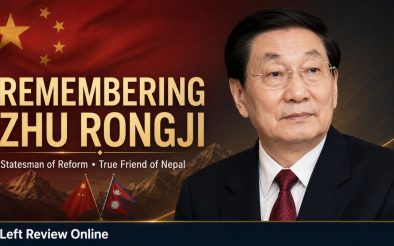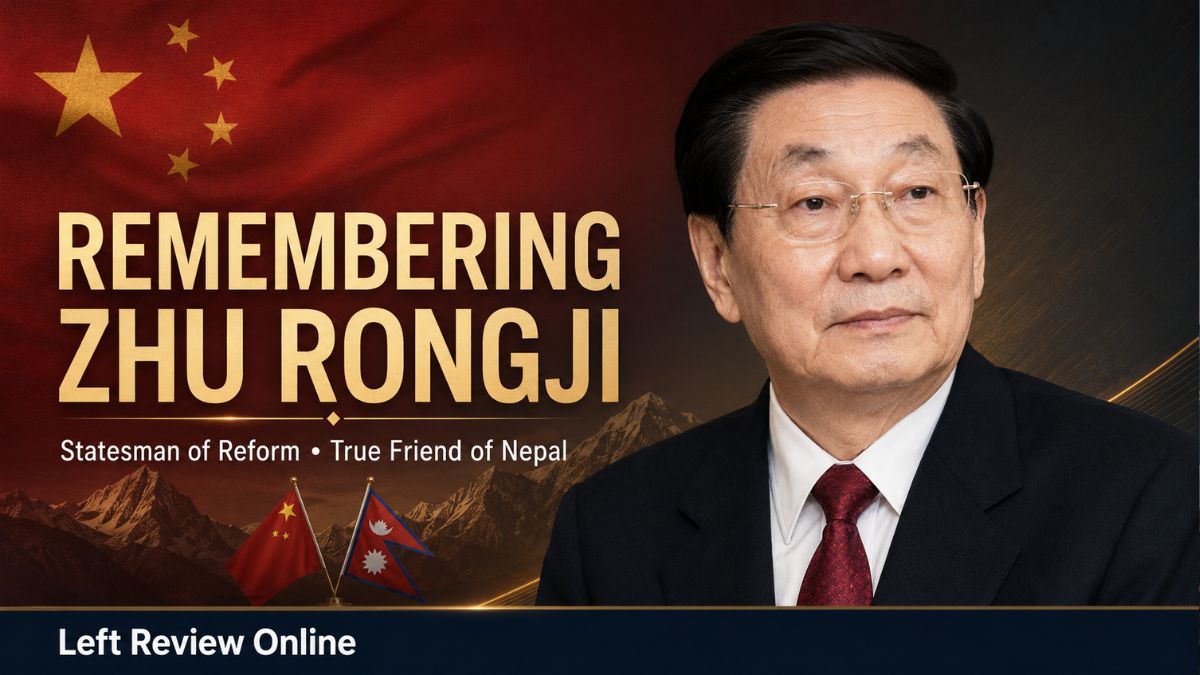
When the history of China’s extraordinary transformation is written, Comrade Zhu Rongji will occupy a place of lasting honour. He belonged to a generation of Chinese leaders who combined revolutionary commitment with administrative discipline, technical knowledge, political courage and an unwavering sense of responsibility toward the nation and its people.
The passing of the former Premier of the State Council of the People’s Republic of China in Beijing on 12 August 2026 is therefore not only a profound loss for China. It is also a moment of sorrow for China’s friends throughout the world, including the people of Nepal.
According to the official obituary issued by China’s leading state institutions, Zhu Rongji was an excellent member of the Communist Party of China, a loyal communist fighter tested over many years, an outstanding proletarian revolutionary and statesman, and an outstanding leader of the Party and the state. These words reflect a life devoted to public service, national development and the cause of socialism with Chinese characteristics.
I extend my heartfelt condolences to the Communist Party of China, the Government and people of China, and the family, relatives, colleagues and comrades of the late Premier. Nepal has lost a respected friend; China has lost one of the distinguished leaders of its modern history.
Leadership at a Decisive Moment
Zhu Rongji served China at a time of immense change. After holding important economic and political responsibilities, including mayor and Party secretary of Shanghai, Vice Premier of the State Council and Governor of the People’s Bank of China, he became Premier in March 1998 and served until March 2003.
This was a decisive period in China’s transition from a planned economy to a socialist market economy. Under the collective leadership of the Communist Party of China, Zhu became one of the foremost architects and determined implementers of reforms intended to strengthen the socialist state, modernise the economy and improve China’s capacity to withstand domestic and international challenges.
His importance lay not simply in supporting reform, but in understanding that reform required capable institutions, sound public finances, effective regulation and a state with the ability to guide national development. For Zhu, economic transformation was not an abstract exercise. It was a demanding process of building institutions, solving practical problems and safeguarding the long-term interests of the country.
He played an important role in reforming taxation and public finance, strengthening the country’s financial regulatory system, modernising state-owned enterprises, restructuring public administration and advancing housing and social-security reforms. He also helped China curb inflation and achieve an economic “soft landing” during an earlier period of overheating.
As Premier, Zhu confronted the consequences of the Asian financial crisis and the catastrophic floods that struck China in 1998. At a time of regional instability, China maintained the value of the renminbi, expanded domestic demand and pursued policies that sustained steady economic growth. This demonstrated not only economic competence but also a strong sense of regional and international responsibility.
Zhu also gave serious attention to agriculture, rural development and the difficult conditions facing workers during economic restructuring. Measures associated with his tenure included experiments in reforming rural taxes and fees, improvements to the grain-purchasing system, support for poverty reduction and the strengthening of basic protections for laid-off workers and low-income urban residents.
These efforts reflected a larger understanding: modernisation cannot be sustained by economic figures alone. It requires institutions capable of protecting livelihoods, maintaining social stability and ensuring that development serves the people.
Reform Guided by National Conditions
Zhu Rongji’s legacy is especially important at a time when developing countries continue to search for their own paths toward modernisation.
China did not simply copy an economic model designed elsewhere. Its reforms were undertaken under the leadership of the Communist Party of China, adapted to the country’s historical conditions and directed toward strengthening national productive capacity. Markets were used as instruments within a broader socialist development strategy rather than being treated as forces that should stand above the state and society.
This experience carries an important lesson for countries such as Nepal. Reform must not mean abandoning national priorities or weakening the public institutions required to protect sovereignty, productive sectors, workers and vulnerable communities. Meaningful reform should enlarge a country’s capacity to decide its own future.
Zhu’s contribution to China’s accession to the World Trade Organization in 2001 must also be understood in this context. He guided difficult negotiations that opened a new phase in China’s engagement with the world economy. China entered the global trading system while continuing to strengthen its domestic productive base, national institutions and long-term development capacity.
The results became visible in the decades that followed. China emerged as a major centre of manufacturing, infrastructure, technology, trade and innovation, while lifting hundreds of millions of people out of poverty and contributing significantly to global economic growth.
No historical transformation is the work of one person. China’s achievements arose from the collective efforts of the Communist Party of China and the labour, discipline and creativity of the Chinese people. Yet Zhu Rongji’s leadership helped construct important institutional foundations upon which later advances could be built.
A Leader of Discipline and Public Responsibility
Zhu Rongji was widely respected for his directness, intellectual clarity, administrative discipline and opposition to corruption. He expected public officials to accept responsibility, speak truthfully and produce concrete results.
The official obituary recalls his insistence that government personnel must remember that they are public servants, have the courage to address difficult problems and work wholeheartedly to accomplish practical tasks for the people.
This conception of public office remains deeply relevant. Political leadership is not merely the occupation of a position. It is a commitment to solve problems, defend the public interest, and accept accountability for the consequences of decisions.
Zhu brought the precision of an engineer to economic administration, but he was never simply a technocrat. His technical competence was joined to political purpose, Party discipline, and a belief in the capacity of the Chinese people to build a strong, modern, and socialist country.
A Sincere Friend of Nepal
For Nepal, Zhu Rongji’s international legacy carries special meaning.
His official visit to Nepal from 14 to 16 May 2001 was an important milestone in the history of Nepal–China relations. It brought the friendship between the two countries into a new century and helped translate political goodwill into practical cooperation.
During his discussions with Prime Minister Girija Prasad Koirala, King Birendra and representatives of Nepal’s political and business communities, Zhu emphasised the long history of friendship between the peoples of Nepal and China. He described China as Nepal’s trustworthy neighbour and friend and expressed China’s willingness to support Nepal’s development efforts.
The visit resulted in the signing of six important cooperation documents. They addressed agricultural cooperation, the avoidance of double taxation, Chinese grant assistance under economic and technical cooperation, the Syafrubesi–Rasuwagadhi road, the Civil Service Hospital and a polytechnic institute. The Federation of Nepalese Chambers of Commerce and Industry’s contemporary account records the breadth of these agreements and the discussions intended to expand bilateral trade and investment.
These were not ceremonial declarations. They helped build practical foundations for cooperation in connectivity, healthcare, technical education, agriculture, trade and human-resource development. The infrastructure and institutions associated with the visit became visible symbols of a friendship directed toward improving people’s lives.
The Syafrubesi–Rasuwagadhi connection carried particular strategic importance. By strengthening a second road link between Nepal and China, it expanded the possibilities for cross-border connectivity and helped Nepal look beyond its traditional geographical constraints. The Civil Service Hospital and technical-education cooperation demonstrated another important dimension of China’s engagement: development cooperation centred on public capacity and social needs.
Zhu also encouraged capable Chinese enterprises to cooperate with Nepali partners and participate in Nepal’s economic development. His approach recognised that friendship must be sustained not only through high-level exchanges but also through trade, productive investment, technology, education and direct cooperation between institutions and peoples.
Equality Between Countries, Regardless of Size
One of Zhu Rongji’s most memorable observations was that Nepal–China relations represented a model of friendly coexistence between countries of different sizes and social systems.
That principle has remained at the heart of the relationship. Nepal and China are vastly different in population, territory and economic capacity, yet their friendship has been built upon equality, mutual respect, peaceful coexistence, non-interference and respect for sovereignty and territorial integrity.
For a smaller developing country such as Nepal, this principle is of great importance. Friendship with China has never required Nepal to surrender its independent identity. On the contrary, China has consistently expressed support for Nepal’s sovereignty, independence, territorial integrity, national dignity and right to choose a development path suited to its own conditions.
Nepal, for its part, has consistently adhered to the One-China principle and recognised that matters relating to Taiwan and Tibet are China’s internal affairs. This political trust provides a stable foundation upon which mutually beneficial cooperation can continue to grow.
Carrying the Friendship Forward
Remembering Zhu Rongji should not be limited to recalling the past. The most meaningful tribute is to carry forward the principles of friendship and practical cooperation that he helped strengthen.
The relationship has since been elevated to a “Strategic Partnership of Cooperation Featuring Ever-lasting Friendship for Development and Prosperity”.
Under the leadership of President Xi Jinping, China has entered a new stage of Chinese modernisation and has presented developing countries with expanding opportunities for cooperation in infrastructure, technology, agriculture, education, health, green development and poverty reduction.
Nepal should engage these opportunities with confidence, strategic clarity and a firm commitment to its national interest. The two countries can deepen cooperation in trans-Himalayan connectivity, agricultural modernisation, climate-resilient farming, renewable energy, technical education, public health, tourism, digital technology and the exchange of knowledge between their peoples.
Such cooperation should bring tangible benefits to ordinary people—peasants, workers, women, young people, students, entrepreneurs and communities in both the mountains and plains. This is how diplomatic friendship becomes a living relationship between peoples.
As geopolitical tensions intensify and attempts are made to divide countries into competing blocs, Zhu Rongji’s vision of peaceful coexistence offers an enduring lesson. Countries with different histories, social systems, and levels of development can respect one another, cooperate for mutual benefit and contribute jointly to peace and development.
A Legacy That Will Endure
Comrade Zhu Rongji’s life was closely connected with one of the most consequential periods in modern Chinese history. He helped guide reform, strengthen national institutions, confront economic difficulties, and expand China’s engagement with the world. He served his country with discipline, courage, and a profound sense of public responsibility.
For the Chinese people, he will be remembered as a loyal communist fighter and distinguished leader who contributed greatly to reform, opening up and socialist modernisation.
For the people of Nepal, he will also be remembered as a sincere friend whose historic visit strengthened political trust and produced concrete foundations for development cooperation.
His passing is a moment of sorrow, but his work remains part of the living history of China’s development and Nepal–China friendship. The roads, hospitals, educational institutions, agreements and relationships associated with his leadership continue to remind us that genuine international friendship is built through mutual respect and practical action.
May his legacy continue to inspire public servants, political leaders and future generations in China, Nepal and beyond.
Heartfelt tribute to Comrade Zhu Rongji.
Deepest condolences to the Communist Party of China, the Government and people of China, and his bereaved family, relatives, colleagues and comrades.
Comrade Zhu Rongji will be remembered with enduring respect.
[The author is a Central Committee Member of the Nepali Communist Party, Member of the party’s Department of International Relations, and former Vice Chairman of the National Land Commission (Government of Nepal).]