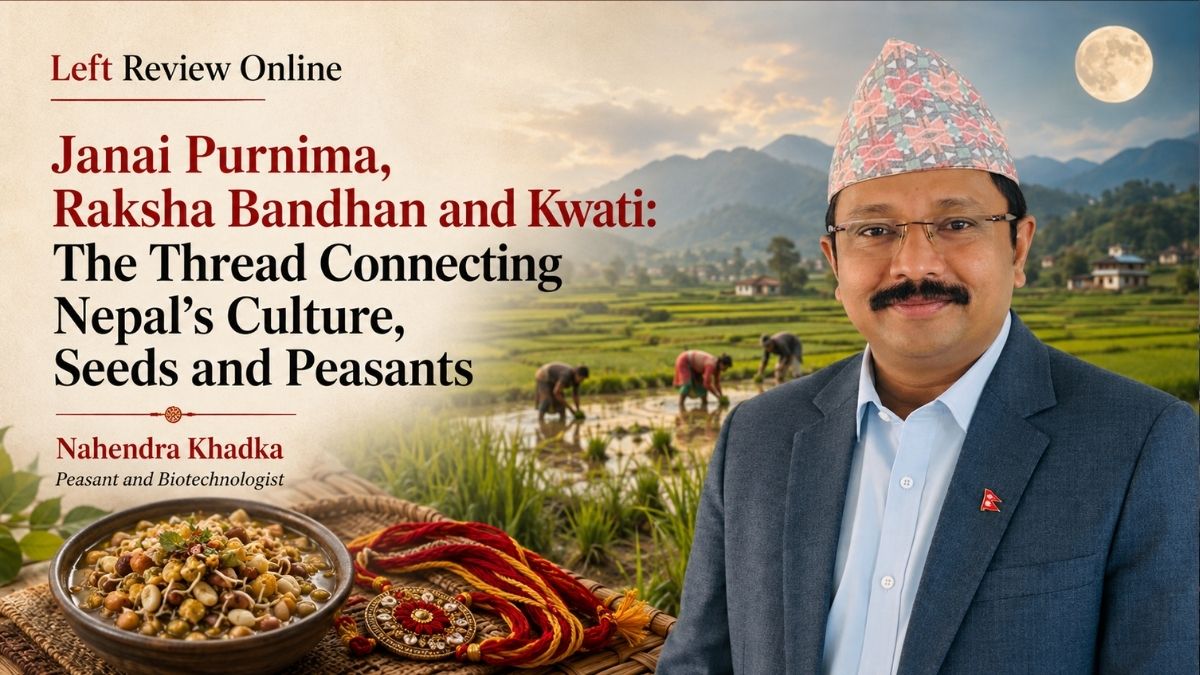
Today, 12 Bhadra 2083—28 August 2026: Janai Purnima. Different communities across Nepal are observing the same full moon through different traditions, beliefs, and cultural memories: Janai Purnima, Rishi Tarpani, Raksha Bandhan, Rakhi, Gunhi Punhi, and Kwati Punhi.
Nepal is a country shaped by diversity. From the Himalayas to the Tarai-Madhesh, not only the geography but also languages, communities, food cultures, clothing, religious practices, systems of production, and ways of celebrating festivals differ remarkably.
The same full moon therefore carries different meanings in different places.
The names are different. The rituals are different. Their religious and historical meanings are not identical.
Yet beneath this diversity runs a common thread: the relationship between family, generations, community, food, nature, land and the people who cultivate it.
Every year on Janai Purnima, Nepal renews more than sacred threads. It renews ties of kinship, belonging and social memory.
Among communities where the Janai tradition is practiced, men replace the old sacred thread with a new one. In some hill communities, sons-in-law traditionally visit their wives’ parental homes and receive or renew the Janai from their fathers-in-law. Daughters return to their maternal homes, sons-in-law are welcomed, elders offer blessings, families gather, and meals are shared.
A religious observance thus also becomes an occasion for family reunion.
As Rishi Tarpani, the day carries traditions of paying respect to sages and inherited spiritual knowledge. Priests tie a consecrated thread—variously called doro, dhago, tago, tao, or other local names—around people’s wrists as a symbol of blessing and protection.
In the Tarai-Madhesh and increasingly throughout Nepal, sisters tie Rakhi on their brothers’ wrists, expressing affection and wishing them health, longevity, happiness, and prosperity.
Pilgrims travel to sacred lakes, rivers and temples, including Gosainkunda and Kumbeshwar. Janai Purnima is a nationwide festival of family gatherings, renewal of the Janai and Kwati, while also noting distinctive observances associated with Gunhi Punhi in the Kathmandu Valley.
Among Newar communities, the day is observed as Gunhi Punhi, with a rich cultural world of its own.
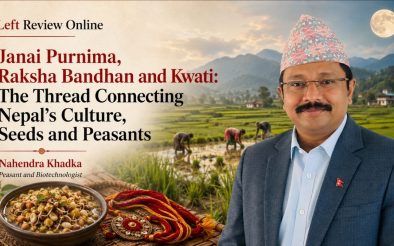
And in countless kitchens, a warm bowl of Kwati comes to the table.
At first sight, these may seem like separate practices. Look deeper, however, and another story emerges: the story of seeds and seasons; rain and soil; food and family; peasants and biodiversity.
Janai Purnima, then, is more than a religious occasion. Within its many traditions survives part of the living memory of Nepal’s agrarian civilization.
One Festival, Many Relationships
One of the most beautiful aspects of Janai Purnima is precisely that everyone does not celebrate it in the same way. Nor should they.
For some, renewal of the sacred thread is central. For others, it is the protective thread. For others still, Rakhi between sisters and brothers, family gatherings, Gunhi Punhi or the preparation of Kwati.
Yet in different ways, each places ‘relationships’ at the centre. The relationship between one person and another. Between daughters and their maternal homes. Between sons-in-law and their wives’ families. Between sisters and brothers. Between elders and younger generations. Between communities and their inherited memories.
And, less visibly but perhaps most fundamentally, between human beings and the natural world that makes life possible.
This is also one of Nepal’s greatest strengths. Unity does not mean making everyone identical.
Real unity grows when different identities, histories and traditions can coexist with dignity, equality and mutual respect. That lesson matters especially in a country as socially, ecologically and culturally diverse as Nepal.
Kwati: A World of Seeds in One Bowl
The agricultural meaning of the festival becomes particularly visible in a bowl of Kwati.
Kwati is prepared by soaking and germinating a mixture of beans and pulses before cooking them together. It is commonly associated with nine varieties, although the actual combination and number differ among households, communities, and regions.
That variation is itself meaningful.
A traditional bowl of Kwati does not depend on one uniform seed. One bean may be black, another green. One is small, another large. They differ in texture, flavour and nutritional qualities. And behind every seed lies an agricultural history—a field, a farmer, a family and often generations of selection, storage and exchange.
For those of us who work with peasants, seeds and food systems, Kwati offers a simple but profound lesson: Diversity is not disorder. Diversity can be resilience.
This is true of society. It is even more directly true of agriculture.
A farming system that depends heavily on only a few crops or varieties can become vulnerable to pests, diseases, climatic shocks, ecological disruption and market instability.
Traditional peasant agriculture rarely depended on one crop alone. There were cereals and pulses. Oilseeds and vegetables. Fruits, herbs and fodder. Livestock and poultry.
Some crops provided staple food. Others protein. Some supported animals. Some helped maintain soil fertility. Some survived difficult weather. Some were preserved because they belonged to festivals, rituals or local cuisines.
Today we call this agrobiodiversity.
For peasants, it was not an academic concept. It was a way of surviving.
Traditional Knowledge Meets Modern Science
Kwati also offers a useful meeting place between inherited knowledge and modern science.
The beans are not simply cooked immediately. They are soaked. They are allowed to germinate. Then they are prepared as food.
Modern food science helps explain some of the value of this practice. Germination can alter the biochemical composition of legumes, reduce some antinutritional compounds such as phytate, and under appropriate conditions improve aspects of protein digestibility and micronutrient availability. The extent of these changes varies by pulse, germination time, and preparation method.
But Nepali kitchens did not begin sprouting beans after reading scientific journals.
People learned through accumulated experience. Which seed should be soaked? For how long? Which beans germinate well? How should they be cooked? Which foods suit which season? What can be stored through difficult months?
This knowledge was produced through observation, repetition, failure, adaptation and intergenerational transmission.
Our ancestors may not have had modern laboratories. But they had another laboratory: life itself. The farm was a laboratory. The kitchen was a laboratory. The forest and pasture were laboratories. Experience was evidence, even if it was expressed in a different vocabulary.
This does not mean every traditional belief is scientifically correct. Nor should tradition be romanticized simply because it is old.
But the arrival of modern science does not make centuries of accumulated peasant and community knowledge irrelevant.
Science can test traditional knowledge. Traditional knowledge can provide science with questions it has not yet asked.
The future of food requires both scientific rigor and respect for accumulated human experience.
A Festival Written into the Monsoon
The timing of Janai Purnima also matters. It arrives during Nepal’s monsoon agricultural calendar.
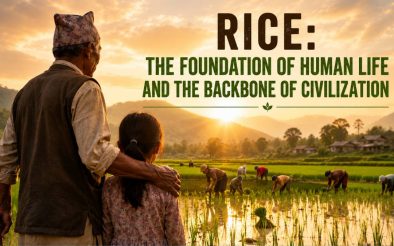
Across much of the country’s rice-growing areas, peasants have by now passed through one of the most demanding periods of the agricultural year.
Seedbeds have been raised. Fields have been ploughed and puddled. Rice seedlings have been uprooted. Transplanting has taken place. Farmers have spent long hours standing in mud and water.
But farming is never only about human labour. The peasant must also read the sky. Did the monsoon arrive on time? Was there too little rain? Too much at once? Did irrigation water reach the field? Did a flood come? Did a landslide block the canal or road? Are pests or diseases appearing? Will the rains stop when the crop needs them to stop?
Modern life can make religious, social and agricultural calendars appear separate.
For earlier agrarian communities, they were much more closely intertwined. Sky, rain, crop, household, and festival belonged to the same rhythm of life.
The full moon falling in the middle of the monsoon was therefore not only a religious moment. It was also a social moment within the agricultural season.
Why Does a Frog Belong in the Story?
One of the most fascinating traditions associated with Gunhi Punhi is Byan-ja Nakegu, the offering of rice or food to frogs.
Seen from an urban apartment, offering food to a frog may appear unusual. Seen from a monsoon rice field, it begins to make ecological sense.
Frogs emerge with the rains. Their calls become part of the soundscape of the monsoon. They inhabit wetlands, ponds, irrigation channels, and paddy fields.
And a rice field is not simply a factory producing grain. During the monsoon, it becomes a temporary aquatic ecosystem. There is water. There is soil. There are microorganisms. There are insects. There are birds. There are frogs. There is rice. And there are human beings.
All are embedded in ecological relationships. Modern ecology uses terms such as food webs, biodiversity, ecosystem functions, and ecological balance.
Traditional farming communities often expressed relationships with the living world differently—through stories, taboos, rituals, festivals and gestures of gratitude.
We should not force every traditional practice into the language of modern environmental science. But neither should we dismiss the ecological memory embedded within culture.
The frog beside the rice plant reminds us of a very simple truth: there is no agriculture without nature.
The Festival Is Visible; Labour Often Is Not
When Kwati reaches the table, we see the finished dish. But how did it get there?
Someone selected the seed. Someone planted it. Someone weeded the field. Someone harvested it. Someone dried it. Someone stored it. Someone protected it from moisture and insects. Someone set aside seed for the following season. Someone gathered the different pulses. Someone soaked them. Someone watched them germinate. Someone prepared the spices. Someone lit the stove. Someone cooked the meal. Someone served it.
The festival is visible. The labour behind it often is not.
For generations, women have carried a large share of the knowledge and labour that sustains Nepal’s agricultural and food cultures.
Seed selection. Home gardens. Livestock care. Food preservation. Food processing. Sprouting. Fermentation. Cooking. Passing recipes and practices from one generation to another.
Yet the final food is often celebrated more than the labour that produced it.
We praise food while forgetting the peasant who produced it.
We celebrate biodiversity while asking too little about whether the people conserving that biodiversity can earn a dignified livelihood.
We praise local seeds while the children of the families preserving them leave agriculture because they see no future in farming.
This is one of the great contradictions of our time.
Can a Festival Survive Without the Peasants Who created It?
Nepal is changing rapidly.
Young people are leaving villages in large numbers. Some agricultural land is becoming fallow. Elsewhere, fertile land is being fragmented or absorbed by unplanned urbanization.
Imported food has become increasingly present in household consumption. Local crops compete with changing diets and commercial pressures. Climate change is disturbing rainfall patterns that farmers learned to read through generations of experience.
None of this means agriculture or culture should remain frozen in the past.
Peasants themselves have always been innovators. They exchanged seeds. Adopted new crops. Changed tools. Adjusted planting calendars. Absorbed new technologies. Experimented with taste and technique.
Change has always existed. The real issue is not whether change takes place. The deeper questions are: Who determines its direction? Who benefits? Who bears the costs? What disappears? And do communities retain the power to decide the future of their own food systems?
We may continue buying nine varieties of beans from supermarkets and cooking Kwati once a year.
But what happens if the farmers growing those pulses disappear? What if local varieties vanish? What if seed knowledge is lost? What if fields lie uncultivated? What if springs and irrigation sources dry up?
Then the form of the festival may survive while its material foundation is hollowed out.
Culture does not arise only inside temples, palaces, and monuments. A large part of Nepal’s cultural heritage was produced in: fields, terraces, forests, pastures, irrigation canals, cowsheds, and kitchens.
The ordinary peasant household is also an archive of civilization.
Expanding the Meaning of “Protection”
The word Raksha carries the meaning of protection.
When a sister ties Rakhi to her brother, the thread carries affection, responsibility, protection, and good wishes. When a priest ties the protective thread, it represents blessing and protection.
But perhaps our time requires us to widen the meaning of protection.
Protect the family—but also protect the peasant who feeds that family.
Protect tradition—but also protect the seeds that make that tradition possible.
Revere rivers—but also protect watersheds, springs, and irrigation systems from pollution and destruction.
Celebrate biodiversity—but also secure the livelihoods of the communities that keep biodiversity alive.
Take pride in food culture—but ensure that everyone has access to adequate, nutritious and culturally appropriate food.
Praise agriculture—but create conditions in which peasants receive dignity and a fair return for their labour.
A thread tied around the wrist represents a promise and commitment. Our generation needs a larger promise: that development will not be built by destroying the soil, water, seeds, biodiversity, peasant livelihoods and cultures on which life itself depends.
From Kwati to Food Sovereignty
A bowl of Kwati eventually leads us to a larger political question: food sovereignty.
Who decides what we grow? Who controls the seed? Who has access to land and water? Can farmers choose their crops and production methods? Can they sell at a fair price? Do local markets survive? Can communities preserve foods that carry cultural meaning? Who shapes agricultural policy—the people producing food, or only distant institutions and markets?
These are not merely questions of agricultural economics. They are questions of power. And that is precisely why food sovereignty matters.
Nepal is unusual in giving the concept explicit constitutional and legal recognition. Article 36 of the Constitution recognizes the right to food and the right to food sovereignty. The Right to Food and Food Sovereignty Act, 2018 goes further: it defines food sovereignty in terms of farmers’ participation in food-policy making, their ability to choose agricultural land, labour, seeds, technology and tools, and protection from adverse effects of commercialization and globalization. It also recognizes farmers’ right to dignity and participation in food and agricultural production systems.
This matters enormously when we look at a traditional food such as Kwati.
Food sovereignty does not mean rejecting every outside food or freezing agriculture in the past.
It means ensuring that peasants and communities are not reduced to passive suppliers at the bottom of a food chain controlled elsewhere.
It means that people should have a meaningful voice in shaping the systems through which food is produced, distributed, and consumed.
It means protecting the capacity to save and choose seeds.
It means defending access to land and water.
It means ensuring fair conditions for producers.
It means valuing local food cultures rather than allowing them to survive only as decorative symbols once their productive foundations have disappeared.
Kwati therefore contains more than taste. It carries the story of seeds. The story of local production. The story of women’s knowledge. The story of peasant labour. The story of markets. And ultimately, the story of who has power over food.
The Lesson of a Sprouting Seed
Hold a dry seed in your hand, and it appears still.
Give it water. Give it the right temperature. Give it time. Its coat breaks. A tiny root emerges. A shoot rises. Life moves forward.
The sprouted seeds in Kwati carry another lesson appropriate to a festival of renewal: possibility exists, but possibility needs the right conditions in order to become life.
A seed needs moisture, warmth and soil. A peasant needs land, water, seed, knowledge, technology, markets and a fair price. A child needs food, education and care. A person needs dignity and opportunity. A culture needs living communities capable of reproducing it. Without those conditions, potential remains dormant.
Nepal is Like a Bowl of Kwati
The beans in Kwati are not identical. That is precisely why the dish is rich. Nepal is not one colour either.
That is precisely why Nepal is Nepal. There are mountains, hills and the Tarai-Madhesh. Many languages. Many communities. Many religions and beliefs. Many food traditions. Many historical memories.
This diversity should not be treated as a problem to be erased. It should be understood as a collective inheritance.
Difference does not automatically create division. Division begins when people cannot live together with equal dignity and mutual respect.
Those who renew the Janai should be free to do so. Those who tie Rakhi should celebrate their relationship. Those who observe Gunhi Punhi should preserve their traditions. Those who prepare Kwati should remember the agricultural history of the seeds in their bowl. Those who undertake pilgrimage should express their faith. And those who practice none of these religious traditions should still recognize the social, agricultural, and ecological histories contained within them.
That plurality is one of Nepal’s great strengths.
May the Thread Never Break
Today we renew the Janai. We tie protective threads. Sisters tie Rakhi. Sons-in-law visit their in-laws. Daughters return to their maternal homes. Families gather. Kwati cooks in the kitchen. Blessings are exchanged.
But alongside these visible threads, we should remember the invisible ones: the thread connecting seed to soil; soil to water; water to cultivation; cultivation to the peasant; the peasant to food; food to culture; culture to community; and one generation to the next.
If those relationships survive, Janai Purnima, Raksha Bandhan, Gunhi Punhi and Kwati Punhi will remain more than rituals repeated once a year.
They will remain living culture.
But if peasants disappear, seeds disappear, soils are exhausted, water sources dry, biodiversity declines and villages lose their productive capacity, the outer form of the festival may survive while its inner life slowly weakens.
So let today’s celebration become more than a greeting.
Let it also become a commitment: Respect peasants. Protect seeds. Defend soil and water. Conserve agricultural biodiversity. Recognize women’s labour and knowledge. Keep local food cultures alive. Strengthen food sovereignty. And turn Nepal’s diversity into a source of equality, solidarity and coexistence.
The sacred thread tied today may one day be removed. But may the deeper thread connecting seed, soil, peasant, food, family, nature and culture never be broken.
Warm wishes on Janai Purnima, Rishi Tarpani, Raksha Bandhan, Rakhi, Gunhi Punhi and Kwati Punhi.
Happy Janai Purnima and Raksha Bandhan.
(The author is the National Coordinator of the National Peasants Coalition Nepal (NIA), a biotechnologist and a peasant leader.)