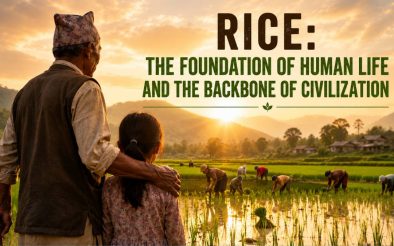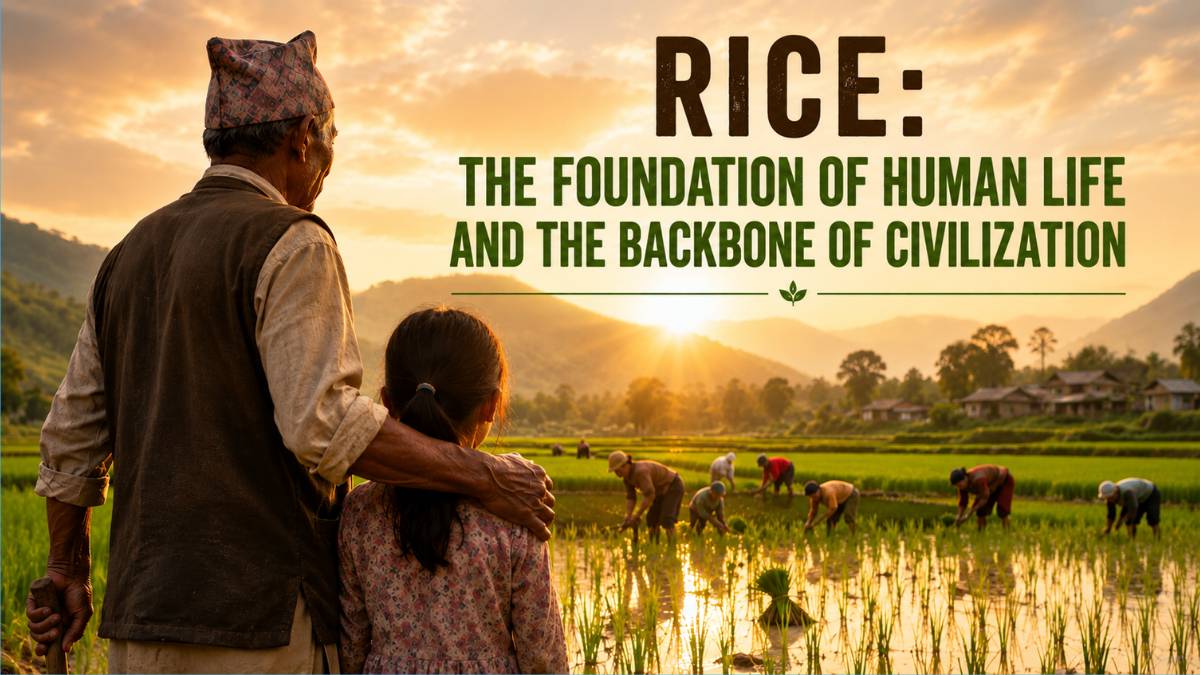
As the first rays of the morning sun spread across the village, an elderly farmer slowly walked toward his rice field. He stood quietly on the narrow earthen ridge, watching the morning breeze ripple through the emerald-green paddy. For a long moment, he said nothing. Then he reached out and gently brushed his weathered hand across the ripening stalks, as though greeting an old friend.
Turning to his young granddaughter, he smiled.
“Do you know, my child?” he asked. “Rice is not just a crop. It is our life. It is our culture. It is our identity.”
The little girl looked at him with curious eyes.
“Grandfather,” she asked, “how can rice be our life? Why is it so important?”
The old farmer lifted his eyes toward the open sky before answering.

“Rice feeds us every day,” he said softly. “When a child is born, rice welcomes new life. In Nepal, during the traditional sixth-day naming ceremony, a lamp is placed beside rice as elders bless the child’s future. During Dashain, Tihar, weddings, and countless festivals, sacred rice grains symbolize blessings, prosperity, and goodwill. Rice is offered to the gods, served to guests with respect, and even accompanies us in our final farewell after death. From the moment we enter this world until the day we leave it, rice walks beside us.”
The little girl fell silent.
She looked across the endless green fields stretching toward the horizon.
The rice plants whispered in the morning breeze, yet they spoke no words.
Still, they carried a story thousands of years old.
It was not a story that began in the palaces of kings or in the proclamations of emperors.
It began in the hands of an unknown farmer.
Thousands of years ago, somewhere in the wild, someone noticed an ordinary grass that others overlooked. Instead of passing it by, they protected it, nurtured it, planted it, harvested it, and saved its seeds for the next season. Then they passed those seeds to the next generation.
That quiet act changed the course of history.
Humanity did not merely cultivate a crop.
It cultivated the future.
From that moment, rice became more than food. It helped people settle, build villages, create communities, and eventually give rise to civilizations. It nourished bodies, shaped cultures, inspired traditions, and connected generations across continents.
Perhaps that is why understanding rice is about far more than understanding a single grain.
It is about understanding the story of human civilization itself.
More Than Food
Throughout history, civilizations have found symbols that define who they are. Some were shaped by mighty rivers, others by mountains, deserts, or seas. Across much of Asia, however, one humble seed became the foundation of life itself.
That seed was rice.
Today, more than half of humanity depends on rice as its primary food. Every morning, billions of people begin their day with a bowl of rice. It fuels workers in the fields, students in classrooms, and families gathered around their tables. In many Asian cultures, asking someone, “Have you eaten rice?” simply means, “Have you eaten?”
Yet rice has never been merely a source of calories.
It is nourishment for the body, but it is also nourishment for memory, identity, and belonging.
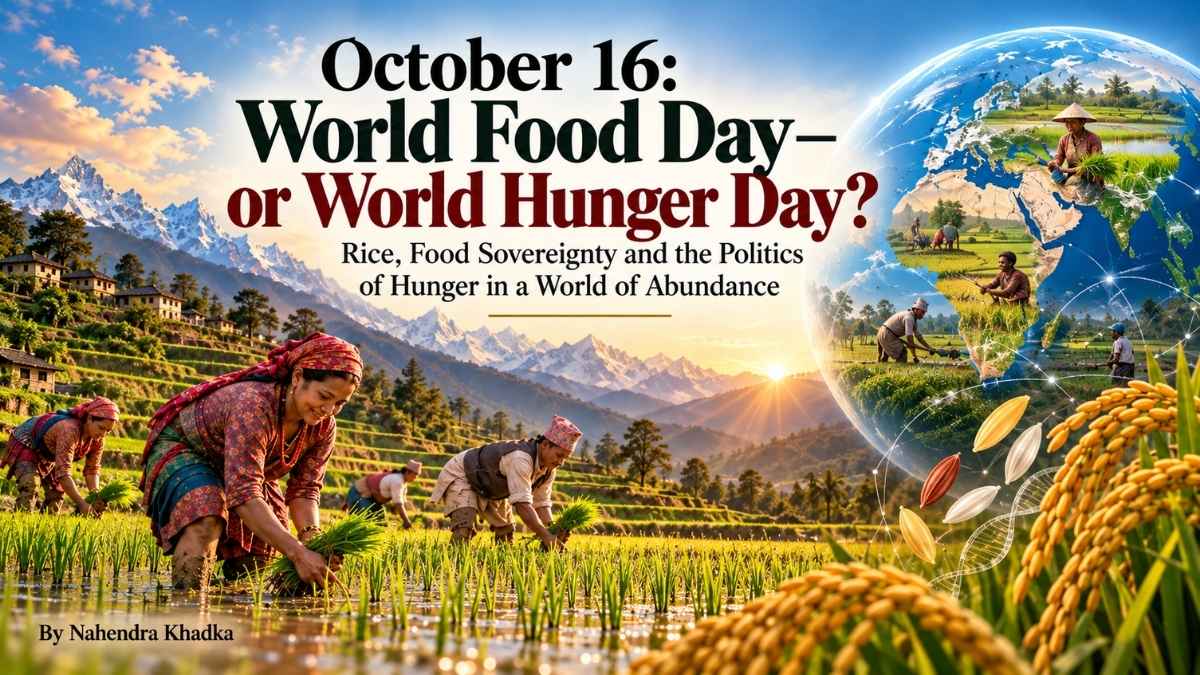
In Nepal, rice is woven into the rhythm of life. With the arrival of the monsoon, villages come alive with the songs of rice planting. Farmers, ankle-deep in mud, transplant young seedlings beneath dark clouds that promise rain. Their laughter echoes across the fields as neighbors work together, turning hard labor into celebration.
Rice accompanies every stage of life. It is present in ceremonies welcoming a newborn child, in weddings that celebrate new beginnings, in festivals that unite families, and in rituals that bid farewell to the departed. A handful of rice may appear ordinary, yet it carries generations of tradition, faith, and shared memory.
Its influence extends far beyond the dinner table.
Rice lives in language, literature, folk songs, proverbs, festivals, paintings, and stories passed from one generation to the next. It has shaped customs, inspired rituals, and strengthened communities for thousands of years.
That is why losing rice would mean losing far more than a crop.
It would mean losing a living heritage.
It would mean erasing part of humanity’s cultural memory.
The Grain That Changed Human History
The greatest revolution in human history did not begin with a king, a conqueror, or a war.
It began with a farmer.
Before agriculture, people survived by hunting wild animals and gathering plants. They wandered constantly in search of food, moving whenever resources were exhausted.
Rice changed that forever.
When people learned to cultivate rice, they also learned to stay in one place. Permanent settlements appeared. Villages grew into communities. Families cultivated the same land generation after generation. Irrigation systems were built, harvests became more reliable, and surplus grain encouraged trade. Trade created towns, and towns eventually grew into cities.
Civilization did not emerge overnight.
It grew season by season, harvest by harvest.
Every rice field became more than farmland.
It became a classroom where people learned cooperation, patience, engineering, and community. Managing water required collective effort. Saving seeds demanded foresight. Sharing labor strengthened social bonds.
In many ways, the rice field became humanity’s first institution of cooperation.
Across Nepal, the terraced hillsides, fertile plains, and river valleys still tell this story. Generations of farmers did not conquer nature; they learned to work with it. They shaped mountains into terraces, guided rivers through irrigation canals, and transformed difficult landscapes into productive ecosystems.
The story of civilization was not written only in palaces, temples, or capitals.
It was also written quietly in muddy fields, where anonymous farmers laid the foundations of the societies we know today.
Perhaps history has remembered too many rulers and too few farmers.
Yet every civilization, no matter how powerful, has rested on the labor of those who grew its food.
The Hands Behind Every Grain
For thousands of years, rice has sustained civilizations. Yet the people who have sustained rice are often the ones least remembered.
Every morning, long before cities awaken, farmers are already at work.
They prepare the soil. They transplant seedlings. They watch the sky for signs of rain. They battle droughts, floods, insects, and disease. They wait through months of uncertainty before a single grain reaches our tables.
Every bowl of rice carries the invisible labor of countless hands.
Yet those hands are becoming increasingly vulnerable.
Climate change is disrupting rainfall and growing seasons. Productive farmland is disappearing beneath expanding cities. Traditional rice varieties are being replaced by a handful of commercial seeds. Many young people are leaving agriculture, uncertain whether farming can still provide a dignified future.
These are not simply agricultural challenges.
They are questions about the future of humanity.
Rice is more than a crop. It is biodiversity shaped over thousands of years by farmers. It is culture preserved through festivals and family traditions. It is food security for billions of people. It is also food sovereignty—the right of communities to protect their seeds, their land, and the knowledge passed down through generations.
If farmers lose their independence, the future of our food becomes increasingly uncertain.
Protecting rice, therefore, means more than increasing production.
It means protecting fertile soil, conserving traditional seed varieties, strengthening rural communities, supporting women who have long safeguarded agricultural knowledge, encouraging young people to see farming as a profession of dignity and innovation, and ensuring that those who feed the world can themselves live with security and hope.
The future of rice will not be secured by technology alone.
It will be secured by valuing the people whose lives remain rooted in the land.
The Story Continues
As evening settled over the village, the old farmer began walking home.
Mud still clung to his feet, and the scent of the rice field lingered in the cool air. Beside him walked his granddaughter, quiet now, holding his weathered hand.
Before leaving the field, she turned for one last look.
Only that morning she had seen nothing more than rows of green plants.
Now she saw something entirely different.
She saw the hands that had planted them.
She saw generations of farmers saving seeds through droughts, floods, and changing seasons. She saw mothers preparing meals from the harvest, communities working side by side during the monsoon, and countless families whose lives had been shaped by a single grain.
She understood that rice does not simply grow in water and soil.
It grows in patience.
It grows in knowledge.
It grows in cooperation.
Above all, it grows in the labor of farmers whose names history rarely records but whose work has made history itself possible.
The old farmer smiled.
He realized that his granddaughter no longer saw only a rice field.
She saw the story of civilization.
And perhaps that is the greatest lesson a rice field can teach.
Long before kingdoms rose, before cities expanded, before nations were drawn on maps, someone planted a handful of seeds and believed in tomorrow.
Every harvest since has been a continuation of that act of faith.
History may celebrate emperors, presidents, and conquerors.
But the foundation of civilization has always rested elsewhere—in the quiet fields where farmers continue, season after season, to plant the future.
Because every grain of rice carries a story.
And every story begins with a farmer.
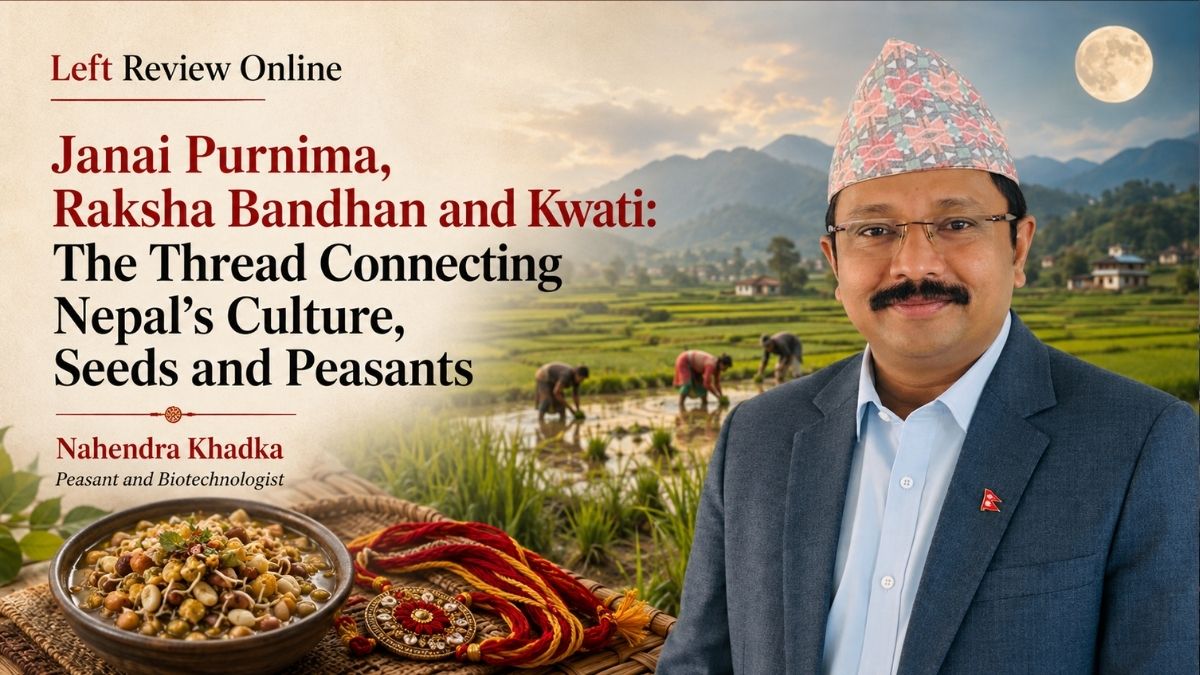
(Writer Khadka is Coordinator of the National Peasants Coalition Nepal, a peasant leader, and a biotechnologist. He advocates for agroecology, food sovereignty, biodiversity conservation, sustainable agriculture, land reform, agrarian transformation, and the rights of peasants and rural communities.)