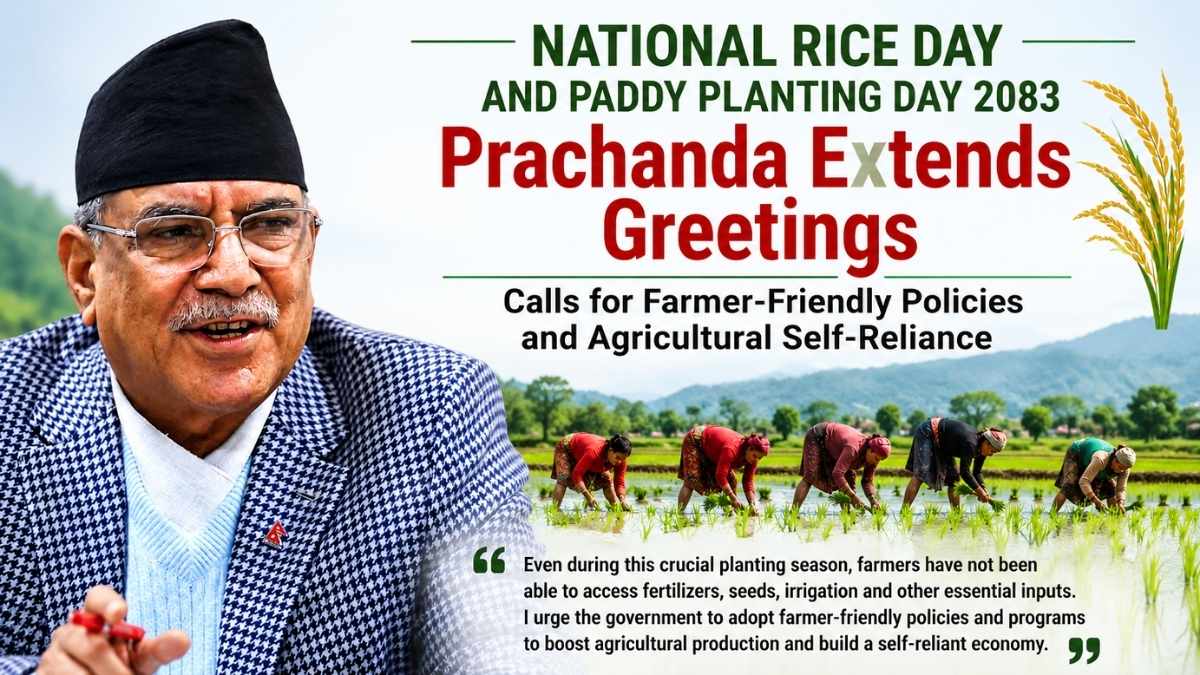
Kathmandu, Nepal. Marking the 23rd National Rice Day and Rice Planting Festival 2083 (2026), celebrated nationwide under the theme “Climate-Friendly Technology, Rice Self-Reliance, and Prosperity,” the All Nepal Peasants Federation (ANPFa) has urged the government to take immediate and concrete measures to address the longstanding challenges faced by Nepali peasants.
In its first official press statement since the unification of the All Nepal Peasants Federation (Revolutionary Centre) and the All Nepal Peasants Federation, the newly unified organization extended greetings to peasants, farmers, agricultural workers, women peasants, youth, Indigenous communities, agricultural scientists, technicians, and everyone contributing to Nepal’s agricultural sector.
The federation described rice as more than just a staple crop, calling it the foundation of Nepal’s civilization, culture, economy, food security, food sovereignty, and national self-reliance.
“For thousands of years, Nepali farmers have sustained the nation through their labor, knowledge, and dedication,” the federation said, adding that National Rice Day should serve as a tribute to the hard work and invaluable contribution of farmers to the country’s development.
Despite agriculture remaining the backbone of the Nepalese economy, the federation noted that farmers continue to struggle with persistent shortages of quality fertilizers, improved and indigenous seeds, irrigation facilities, agricultural machinery, affordable credit, reliable markets, and fair prices for their produce.
The statement warned that rapid fragmentation of arable land, uncontrolled urban land plotting, increasing dependence on imported food, the growing impacts of climate change, rising production costs, and inadequate public investment have pushed Nepal’s agricultural sector into a deepening crisis.
To address these challenges, the federation called on the government to ensure the timely supply of quality fertilizers, improved and local seeds, irrigation facilities, and other essential agricultural inputs.
It also demanded the introduction of a Minimum Support Price (MSP) for rice and other major agricultural commodities based on scientific production costs, backed by an effective government procurement system that guarantees farmers fair and remunerative prices.
The federation further urged the government to protect agricultural land from uncontrolled fragmentation and conversion to non-agricultural use, conserve indigenous seeds and local rice varieties, promote biodiversity, and prioritize climate-resilient farming practices.
It also emphasized the need to strengthen agricultural insurance, expand social security for farmers, provide concessional agricultural credit, improve agricultural marketing systems, and significantly increase public investment in irrigation, research, mechanization, storage, processing, extension services, and rural infrastructure.
Reaffirming the constitutional guarantees of the right to food, farmers’ rights, and food sovereignty, the federation stressed that these rights must be fully implemented in practice rather than remaining constitutional commitments on paper.
“The prosperity of farmers is the foundation of national food security and sustainable development,” the statement said.
On the occasion of the National Rice Day, the federation also called on peasants (farmers) across Nepal to increase agricultural production, protect farmland, conserve indigenous seeds, adopt climate-friendly farming technologies, and strengthen the movement for farmers’ rights and food sovereignty.